Cezar Mocan’s Non-Playable Worlds
The 2025 winner of the Arab Bank Switzerland Digital Art Prize on generative landscapes and the long history of looking at nature through a screen.
The first landscape paintings appear in the Western cultural record around the time the first telescopes were being built. The printing press is older than the tradition of landscape painting, as is double-entry bookkeeping and the standardised time of the mechanical clock. The desire to contemplate and capture the beauty of nature, in other words, arose in artists only after these instruments of modernity had taught them to see the world as something to be sectioned off, copied and circulated as bundles of abstract information. In landscapes, we encounter nature not as a fecund tangle of systems, but a flat encoding—something “out there” seen from within our own alienated position without, as if on a distant screen.
Exemplary of the tight coupling between the natural world and the technological regimes that represent it is the Claude glass, an 18th-century novelty trinket that was both a product of romantic admiration of nature and a means of keeping it at a safe distance. The Claude glass was a mirror tinted with a gauzy sepia texture that rendered whatever appeared in its reflection in the signature style of the early landscape painter Claude Lorrain. Users would turn their back on the actual scene before them and instead look at the more-perfect simulation of nature captured in their palm-sized mirror. The images held in the Claude mirror can be understood as a distant ancestor to the picturesque desktop backgrounds of Windows XP or the more recent trend toward what art critic Ben Davis has termed “nature slop”: “plausibly uncanny AI-generated images of natural tranquillity that serve as a pleasant stimulus filling the void left by genuine social connection on increasingly hollow platforms.” In this lineage, natural wonder is not only a pleasant counterweight to technological progress, but a showcase through which to demonstrate its feats.
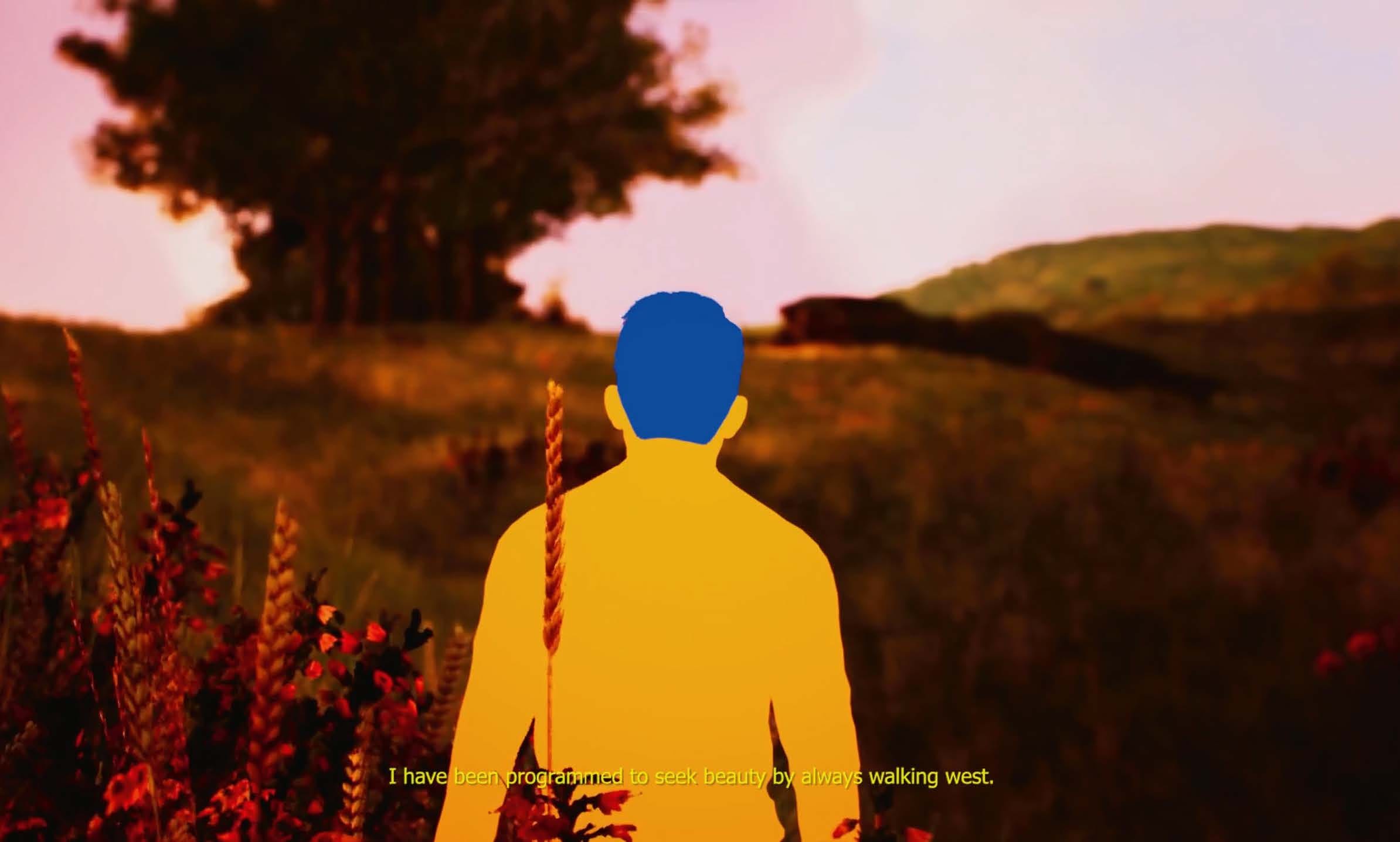
The Claude glass makes a small appearance in Romanian artist Cezar Mocan’s Arcadia Inc (2021–2024)—a real-time computer simulation in which three agents wander a bucolic landscape to capture a “clean, context-free alternative to nature imagery”—but it is a fitting emblem for his practice as a whole. Mocan works with game engines and other generative computer systems to create self-playing virtual worlds steered not by linear narrative but the emergent interplay of the programmed systems that compose them. Like the image reflected back in the Claude glass, these simulations are sealed off from the world outside. Unlike that insulated hyperreal image, however, Mocan’s works will continuously output novel interactions until the GPUs running them stop spinning, indifferent to the presence or absence of an audience of contemplative romantics.
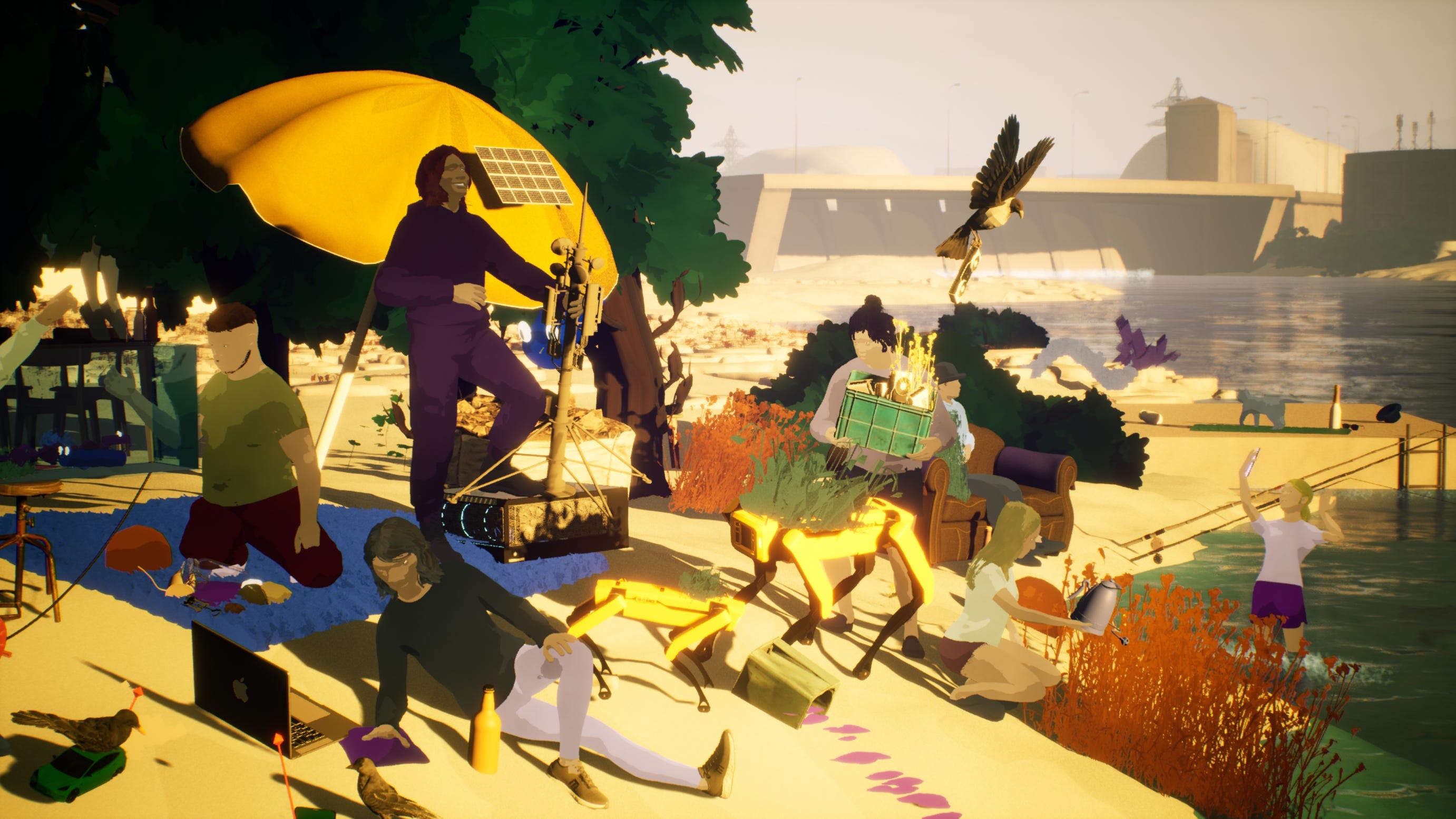
World Upstream (2023–2024), for which Mocan was awarded the Arab Bank Switzerland Digital Art Prize last year, extends this inquiry into technology, nature, and enchantment. Set in a fully automated future on the banks of a hydroelectric dam slowly being sucked back into the surrounding wilderness, a cast of characters programmed to balance competing needs such as “cacophony,” “togetherness” or “curiosity” are having an endless picnic to pass the time. Accompanied by animistic “smart objects” such as a sentient Dyson vacuum, the character’s desire-functions collide and recombine into an ambient drama that teeters between long periods of stillness and eruptions of physical comedy, where characters wave their hands and sprint across the screen. In an era when the dominant user experience of technology is one of spellbound immersion, Mocan’s slow, self-editing cinema invites the viewer to devise their own fantastic interpretations of what the non-human system before them might possibly mean.
On the occasion of the presentation of Arcadia Inc as part of Arab Bank Switzerland’s SYSTEMS exhibition at NFC Summit, held in conjunction with this year’s Digital Art Prize, Guy Mackinnon-Little spoke with Mocan about suburbs, phantom islands and the value of futility in the face of accelerated technological change.
Guy Mackinnon-Little: What landscapes, real or virtual, have been formative for you?
Cezar Mocan: In terms of actual landscapes, three come to mind. The first is one I encountered as a child on a road trip with my parents. We stopped at this field of poppy seeds in Transylvania in Romania, where I grew up. It was very simple and pure. Green grass. Red poppy flowers. Blue sky. I think it was the first time that I felt emotionally connected to a natural landscape simply through its beauty. When I was doing research for Arcadia Inc. I became obsessed with Larry Abramson’s essay “What Does Landscape Want?” His core claim is that the landscape wants us to let go of critical thinking and become enchanted. I think that was the first time that I became enchanted in the way he describes.
The second one, also from childhood, is the “bliss.png” Windows XP desktop—the one with the green rolling hills and the blue sky. I became quite obsessed with that image in college and went on to make some works about it. Enough time had passed from Windows XP’s peak, 10-15 years, so it started showing up in my feeds as nostalgia content. That made me remember the strong sense of potential I had felt from this image as a child, and I started asking myself questions. Why did that image in particular speak to me? Why was it luring me in towards the computer? What kind of desire was that? Broader ones as well, like why were most Windows XP default wallpapers images of nature? Why did that tradition, of bringing in a landscape photograph as a default choice on the desktop, hold in later versions of Windows, and start being used by MacOS as well? And where does this gesture performed by Silicon Valley sit within the histories of the graphical user interface and of landscape representation?
I saw the third one maybe five years ago, during the pandemic. I was visiting my ex-partner’s family in Northern Virginia in the US, and they live in a classic American suburb, maybe an hour away from DC. On the edge of their neighbourhood was a strip of unmanicured grass, with a basketball court at one end and power lines running overhead into the neighbourhood. That place felt special to me because it represented a distinctly 21st-century sublime. It was the only “natural” thing in this zone of perfectly manufactured grass, but the power lines and the basketball court were very much part of my enjoyment too. It led me to appreciate the natural landscape more while removing the word “natural” from it. Nature doesn’t exist anymore. Everything is industrialised, with these infrastructural parts built in. That was the first time I felt those parts making their way into my affective response to a place.
GML: It’s interesting that when you think about the relationship between nature and technology, you talk about particular places and memories rather than treating them as these philosophical abstractions.
CM: The more I think about those two words and the relation between them, the more the boundaries dissolve. The division is much less obvious in the simulations I design, which are autonomous systems trying to regulate themselves.
GML: Do you think a viewer of your work needs to understand the inner workings of those systems to get something from them? You usually present your work with the gaming PC running the simulation in full view. It feels a bit like a magician showing the sleight of hand behind a trick. Why is it important to you to showcase the substrate of the world rather than just the world itself?
CM: Revealing a little bit of the magic trick in my work is important as a gesture against the technology industry’s tendency to claim that everything is magic. The claim that everything is so powerful that we cannot understand it is a way of diminishing human responsibility over those technologies.
Whether the viewer understands the generative system behind the work is less important to me. I recently did a workshop with the curator Nora N. Khan that really changed my understanding of emergence. [Editors’ note: this workshop formed part of the Centre d’Art Contemporain Genève’s Agora program, for which Arab Bank Switzerland was the main sponsor.] To say something is an emergent property of a system is to imply that it cannot be explained by any of its parts. It claims unknowability for something that is not yet known rather than genuinely unknowable. I used to have a lot of problems with that concept because it can be used to abstract away something we don’t yet understand. But Khan led me to see emergence as something experienced rather than as an intrinsic property of a system. What I’m interested in is what else emerges in the viewer’s mind when they look at my work, how they complete the system. What kind of meaning does the viewer start to bring to seemingly arbitrary gestures?


GML: How did you come to work with simulation as a medium? What experiences or decisions were most consequential in giving your practice its distinct shape?
CM: I started programming quite early in life. I was 10 when I took my first classes and did competitive programming throughout my school career. I moved towards my future with the idea that I would become a software engineer, that programming would forever be my identity and my profession. The identity part is still true; the profession, maybe not so much. Even the identity part is starting to dissolve a little with vibe coding and AI models capable of that kind of work.
I had basically no interaction with art until university, when I took a photography class in my first year that was maybe the most influential thing I’ve done. I keep seeing connections back to that one semester, even in what I’m doing now. I was taught by Victoria Sambunaris, who works in the tradition of New Topographics, a photography movement from the 1970s that looked at the natural landscape as something inextricably altered by humans. The class showed me a different way of making. I was used to working in a the sandbox of the computer, engineering everything from the bottom up. With photography, you instead have to observe, be patient, and push the button when things feel right.
Towards the end of university, I started realising these two interests didn’t have to be separate, that there were scenes and worlds that merged them. My first understanding of that was through Net Art, the current of artists using the web browser and networked media as a medium in the 90s and 2000s. My first works involving computer programming were all web-based, within that tradition: not so much systems or worlds as small gestures and interventions, which the browser lends itself to.
From there, I moved towards generative art. I worked with a pen plotter for a minute and fell in love with it as an object, but I was feeling a disconnect. The research process is maybe my favourite part of what I do—those months at the beginning of a project—and with traditional generative art, I couldn’t find a way to translate that research into abstraction. That pushed me towards game engines, where you have the same ideas and frameworks as generative art, but in a way that’s more figurative, more narrative, and lets me obsess over an idea, research it for a while, and then develop it into a system.
GML: Tell me more about that process. How do these worlds come together for you, practically and conceptually?
CM: It’s very difficult for me to experiment without a plan, so that’s how it always starts. I work on these projects over one or two years, and the first six months are usually just research—I become fascinated with an idea, sometimes from a painting, sometimes from a line in a book, and I spend those months trying to learn as much as I can, pulling visual references. Before I start experimenting with generative systems, I need to have an internal understanding of what the world I’m trying to create looks like: who lives there, who doesn’t, what its boundaries are, whether it has boundaries, all of that.
Once I have that understanding, I start to figure out the little clock wheels that make that world work. World Upstream, for example, uses utility AI quite a lot, which is very similar to the system used in The Sims. Every character and every entity in the world is trying to achieve homeostasis or equilibrium across multiple axes. In The Sims, those utility functions are anchored to mundane needs like eating or sleeping. In World Upstream, they’re more abstract: nostalgia, curiosity, cacophony, togetherness, nesting. That structure makes sense for the story I was trying to tell with that work, shaping the interactions among characters and their world as they attempt to fulfil those needs.
It’s different in other cases. End of Signal is a new extended project I’m working on about a satellite that becomes an unreliable narrator of on-the-ground reality. One piece within the project—what I’m working on at the moment—is my first digital simulation that isn’t built in a game engine but rather through an AI model, a fine-tuned diffusion model. I’d been looking at phantom islands, places from the history of cartography that were discovered and then had to be undiscovered, because they didn’t actually exist, but persisted on maps for decades or centuries before being removed. They felt like highly relevant precedents for the unreliable satellite. The series, Searching For, follows the satellite’s AI as it traces a passage toward a single phantom island, using historical descriptions from the navigators who first “discovered” it. There are three components: a generator that creates moving-image sequences of satellite imagery of fictional islands from a given set of parameters; a judge that compares the resulting images against the historical descriptions and assigns scores; and an optimiser that pushes the generator’s parameter space toward higher scores, toward pleasing the judge. I’m thinking of it as the satellite AI’s walk down its own memory lane—a search for the seeds of fiction in its allegedly objective training data. Of course, it’s a futile search, as it often is in the projects I make.
GML: How does that idea of futility show up as a theme across your practice?
CM: In some sense all of the projects that I do are the same project. The boulder is swapped out, but I’m essentially creating an AI Sisyphus in each case. There’s something about this perpetual attempt of a system to reach a state that never arrives—perpetuity without progress—that underpins all of my work. I am driven by a strong desire to understand technology in the present moment, which in this time of accelerated progress often feels like a similarly pointless or at least overwhelming pursuit. Maybe the futility of my own systems is a reflection of my own feelings about trying to make sense of the present while progress marches on.
Another part goes back to the non-playability of the worlds I make. In creating these simulations, I provide the entities inside them with agency and protect them from outside interference. However, doing so also withdraws agency from the viewer. No matter how much they want to interact with it or change something, they cannot. It’s impossible. For me, if the desire to interfere arises and remains unfulfilled, that makes the work stronger. It clarifies the idea of agency and its limits in the viewer’s mind.
Cezar Mocan is the recipient of the 2025 Arab Bank Switzerland Digital Art Prize. Arcadia Inc (2021–2024) will be included in the SYSTEMS exhibition presented in conjunction with this year’s prize at NFC Summit from 4-6 June 2026.
Photography by Bruna Buniotto.