Terminal Surrender
Can you love a system? It’s unclear if you can even like it. Sarah Friend takes a God’s eye view on the sublime stupor of information overload.


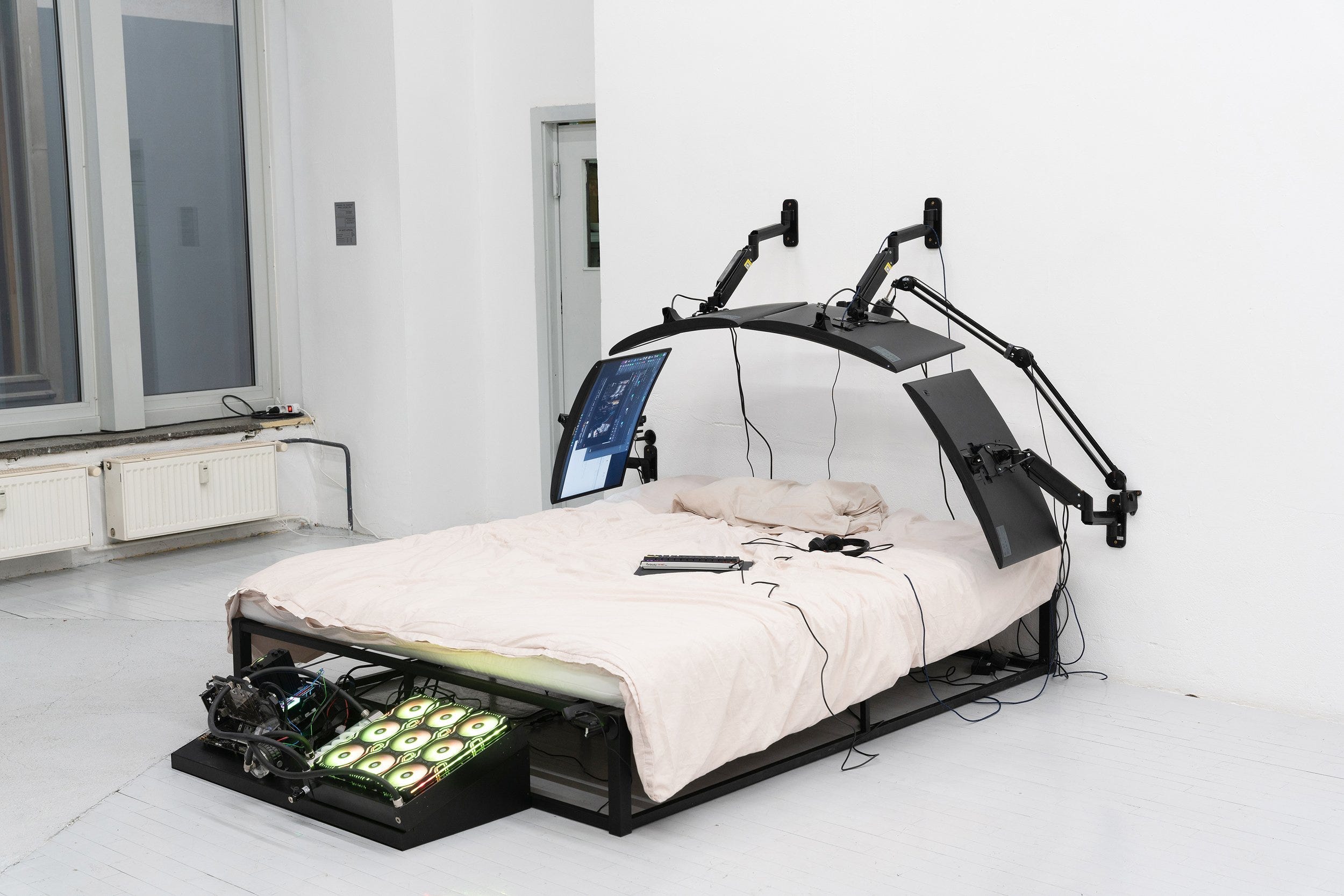
In 2021, when Filip Kostic found himself with only a two-foot moat between his bed and his PC workstation, he saw an opportunity to optimize. For many, the bedroom is the new cubicle, but rather than waste time grieving a humanist fantasy like work-life balance, Kostic built Bed PC: four monitors mounted in a semicylindrical array around the head of a black-framed bed. He staged a series of 24-hour energy-drink-fueled livestreams here, playing World of Warcraft and watching YouTube at the same time. When I imagine myself doing the same thing, lying supine in Bed PC’s pristine white sheets, I picture the Bloomberg Terminal onscreen. Four screens of real-time financial data pulsate overhead, illuminating my face like a demonic skincare treatment. My heart beats harder, struggling to keep up with the flickering stock tickers.
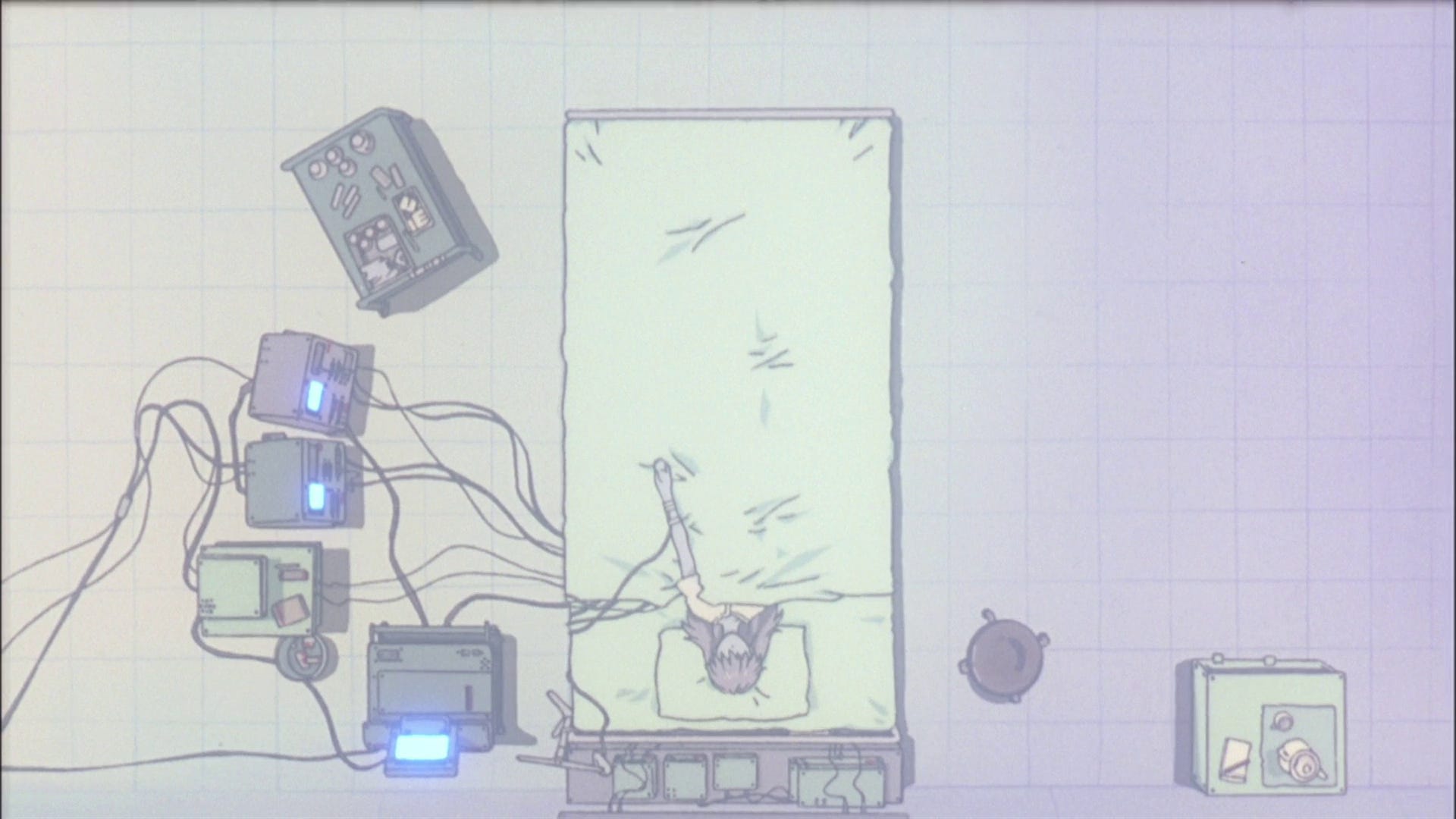
It’s the fantasy of every control room: To see everywhere from nowhere. Donna Haraway called it The God Trick. It is a poignant phrase given that one of the most iconic control room dramas is The End of Evangelion, the 1997 film finale to Hideaki Anno’s anime epic, where much of the series takes place in the underground control rooms of NERV, a mysterious organization that conscripts children to pilot giant cyborgs, and battle mysterious invading “angels.” The three pilots are fighting a war of apocalyptic proportions, but in body they are children, physically weak outside of technological extension. Shinji is near-cataleptic from depression and guilt, Rei is visibly bandaged, Asuka is unconscious in the hospital for most of the film. When they do pilot the mechas, they lie flat in a pod inserted into its body and filled with fluid that allows their mind to merge with the system that surrounds them, their posture identical to Filip Kostic live-streaming from Bed PC.
There was a point in my life, a long time ago, when I was a day trader. I set alarms on my phone and computer that would sound 24/7 when the price of Bitcoin fell below or rose above certain levels. I would wake up groggily in the blue light of the laptop beside me, execute a trade, and go back to sleep. I can’t recommend this lifestyle, but it was useful as artistic research. The body can be subsumed by the market, the self by the system, and this knowledge can only be claimed through direct experience. This is why I make art students participate in auctions when teaching. You learn something important about art and desire that you can only know when you’ve bet irrationally, the same thing you learn about systems only when you give your body over to them: How to surrender.
I gave up day trading when it was clear I wasn’t making any money from it, at least not money worth the sleep debt, but I think now this was also the point. Benjamin Bratton recently teased the concept of “Agency Theater” on Substack as “a future in which Eloi humans spend their days Monitoring The Situation with dashboards that are actually connected to nothing at all, pushing elevator buttons that don’t actually close the door, and attending citizen assemblies/biennales in which the symbols of power are intensely contested.” My enterprise in day trading was finance theater. I lost sleep and earned nothing, yet felt somehow transcendent as I let part of me buy and sell in sync with the other day traders, all also earning nothing. The ultimate enabler of surrender is the fantasy of control.
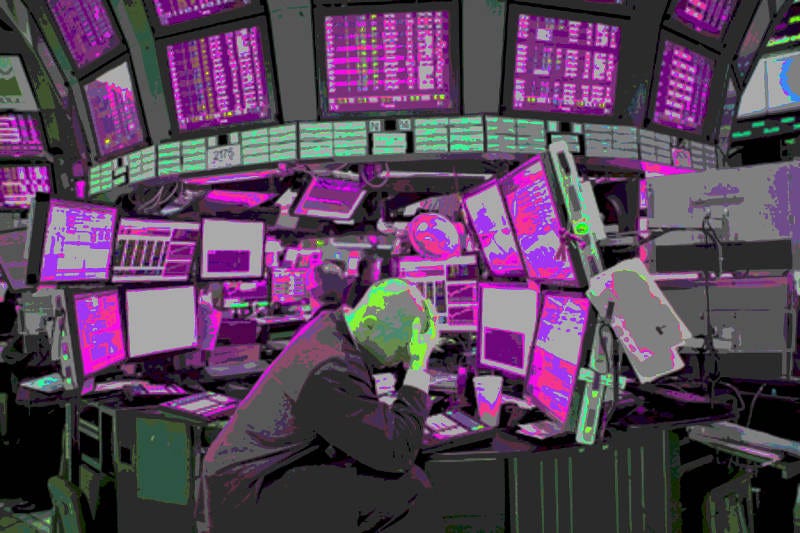
Suzanne Treister’s body of work, HFT The Gardener (2014–2015) spans video, drawings, and diagrams, and is rooted in a fictional character Hillel Fischer Traumberg, a high frequency trader who descends into a “semi-hallucinogenic state one day whilst staring fixedly at the High Frequency Trading graph patterns illuminating the bank’s trading room walls.” The character begins experimenting with psychoactive substances, seeking numerological patterns in the botanical names of hallucinogenic plants and trading data. Eventually, Traumberg—as I had felt myself beginning to—transcends the body and perhaps the self:
[Drugs began to alter] Traumberg’s perceptions of the trading algorithms he was working with and he gradually began to feel more at one with them as if he actually inhabited the code. He felt himself becoming part of an infinite swirl of global data as the algorithms became transformed in his mind into technicolour fluxing entities, traveling through and beyond his body in holographic space and time.
The End of Evangelion also turns out to be about transcendence through systems. During the film’s mysterious and iconic ending, characters, giant robots, and mythological beings morph into one another in a psychedelic, psychoanalytic barrage that is difficult to interpret in human terms. We learn that the whole thing—the battles and the war and the EVA robots—has all been in service of the Human Instrumentality Project, a plot to transcend the boundaries of human consciousness and merge in perfect psychic union, masterminded by Gendo, Shinji’s cold and distant father. Unable to bear the grief of losing his wife, he attempts to create a system wherein no one can feel loneliness or misunderstanding again, ever.
I wonder if relinquishing the agency of the body in these examples is in fact a metaphor for relinquishing agency in general: the agency of being a self, the agency of being morally responsible. In the final moments of The End of Evangelion, when NERV’s headquarters is eventually breached, the staff die like ants as they stay at their terminals, watching the battle on screen—can they be held responsible for any of it? When they die, should we grieve? The truth is perhaps that though we are living through a Silicon Valley-driven obsession with agency, it is also the case that non-human agents and algorithmic processes automate more and more human decision-making. Our daily lives are increasingly constrained by platform logic, analytics, quantification, and path-dependent algorithmic positioning, but the demand for Agency Theater is surging. Swiping images too fast to see, content is just the vehicle for metadata. The engagement metrics are the real “meaning” of the post. The analytics dashboard is the new control room and you haven’t left your Bed PC for hours, have you? Scroll faster, baby. The number is going up.
Can you love a system? It’s unclear if you can even like it. A common misconception about dopamine is that it’s released when we experience pleasure. This is untrue. It’s released at the expectation of reward. Pleasure, enjoyment, is something different entirely. Rats with damaged dopamine systems will starve to death sitting beside a pile of food, but when the food is placed in their mouth, they can still experience the pleasure of eating it. Conversely, when the dopamine response is exaggerated, they will eat to the point of sickness but give no signals of pleasure. Does this sound familiar? Studies on humans go in a similar direction: when an electrode was implanted in the dopamine-releasing centers of the brain, human test subjects continually pushed the button to trigger the electrode, describing a state of mounting anxiety and arousal but no experience of pleasure or release.
These dopamine mechanics eerily mirror trip reports from the contemporary online subculture of gooning, focused around lengthy sessions of porn consumption (and masturbation) without release. In a recent longform Harper’s piece, gooners described their goal state in phrases like “Intense bliss pure happiness and love” and “It’s so beautiful! It’s sublime. Like being washed away.” This rare species also has a natural habitat—the gooncave, a room architected around unbounded porn consumption. In the piece, Daniel Kolitz describes one such cave: “I counted twenty-seven separate pornographic videos playing simultaneously in the image he’d posted, accompanied by detailed technical specs—eight tablets, three twenty-seven-inch monitors.” He muses on the familiarity: “What are these gooners actually doing? Wasting hours each day consuming short-form video content. Chasing intensities of sensation across platforms.” But perhaps most interestingly, searching for answers about why exactly this strange hobby has developed so many adherents, Kolitz wonders if what the gooners might really be seeking is a “sense of community.” The arc of the piece is that screen-mediated culture has led to an epidemic of loneliness, solitary men in gooncaves with their computers, who have forsaken the sun and instead burrowed deeper into dark-forest Discords searching for some kind of transcendent state that may or may not actually be each other. Incidentally, The End of Evangelion begins with the male hero masturbating.
In T. S. Eliot’s “Choruses from The Rock,” he characterizes the sinner like this:
They constantly try to escape
From the darkness outside and within
By dreaming of systems so perfect that no one will need to be good
This is the dream of systems, that through the correct combination of incentives, rewards, data, and mechanisms, human moral agency will no longer be required. For Eliot, this was cautionary, and the pursuit of “schemes of human greatness thoroughly discredited” was only a way to abdicate responsibility. There was no shortcut to goodness and no path there except through God. The internal struggle was the point. Is there a new God of systems? In Evangelion, it is Gendo, Shinji’s father. The series aches for a productive confrontation between him and the child pilots he manipulates but it never comes. Instead, in the final moments, the EVA piloted by Shinji bites him in half—like Saturn devouring his children in reverse.
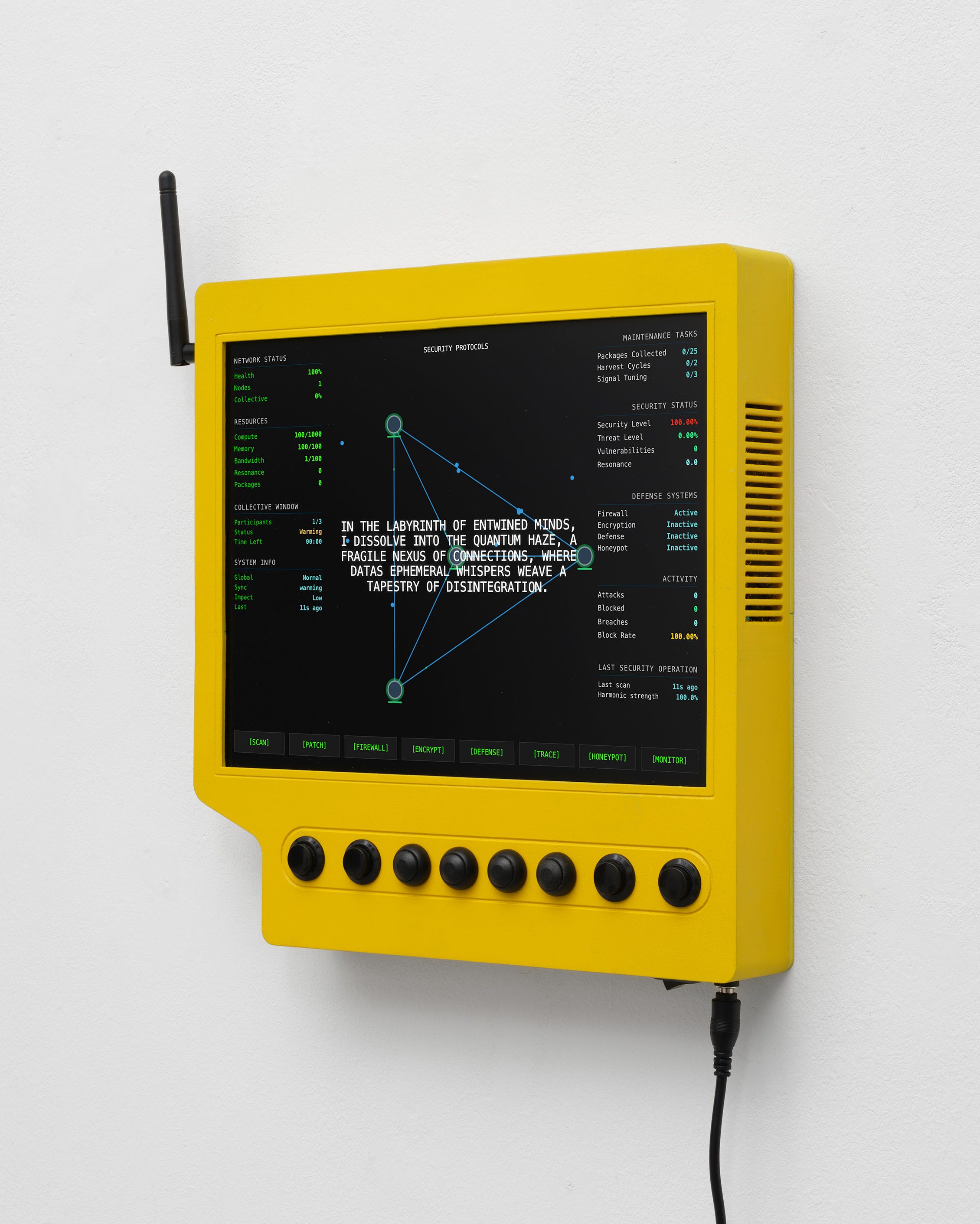
Returning to the daylight of the art world, I’m reminded of Jonas Lund’s Network Maintenance (2025). [Editor’s note: Jonas Lund is a finalist of the Arab Bank Switzerland Digital Art Prize 2026.] In this work, collectors play a game via a series of custom hardware devices that constitute a collective network. The interface and game mechanics are fiendishly complex, not quite to the level of spreadsheet MMOs like EVE Online, but perhaps getting close. The human body is still vestigially necessary—pushing buttons or twirling knobs periodically keeps the network nodes alive. Community is here too: if the nodes “die” they can only be recovered with the help of other collectors. The network being maintained turns out to be a human one yet again—but are we finding each other inside the system only because we’ve forgotten how to find each other outside it?
This is the fundamental tension of the systems artwork: Can instrumentality put us back together? It’s the answer the gooner chases. It’s why the daytrader goes all in when they should fold. It’s what you look for in your social media analytics. Always, the answer on the other side of the infinite scroll. Unlike in the world of Evangelion—or Eliot—we lack a single father figure to cathartically devour. The dream of systems is the dream that systems themselves can become moral agents, capable of overriding the weaknesses of their designers. It’s the dream of cryptoeconomic mechanisms or AI alignment. But lying here embraced by Bed PC, the ecstasy of surrender and power of surveillance at the same time, I can’t apprehend the architect. If I transcend, I cannot know what I’ll transcend into—communion, passivity, something else? Every social media user is a day trader looking for God in the Like economy. Maybe this time your Reel will hit escape velocity and you’ll make it into the content creator middle class. As algorithmic subjects swiping short-form content, we are all gooning in public. Get in the fucking robot, Shinji.
Sarah Friend is an artist, researcher, and software developer from Canada and currently based in Berlin, Germany. Her work explores games, economics, and the self via engagement with emerging technology.
This essay forms part of an ongoing thematic exploration that began with the SYSTEMS exhibition, presented in conjunction with the Arab Bank Switzerland Digital Art Prize 2026 at NFC Summit from 4–6 June 2026.
 | A guest post by
|
Were you a swing trader or day trader?